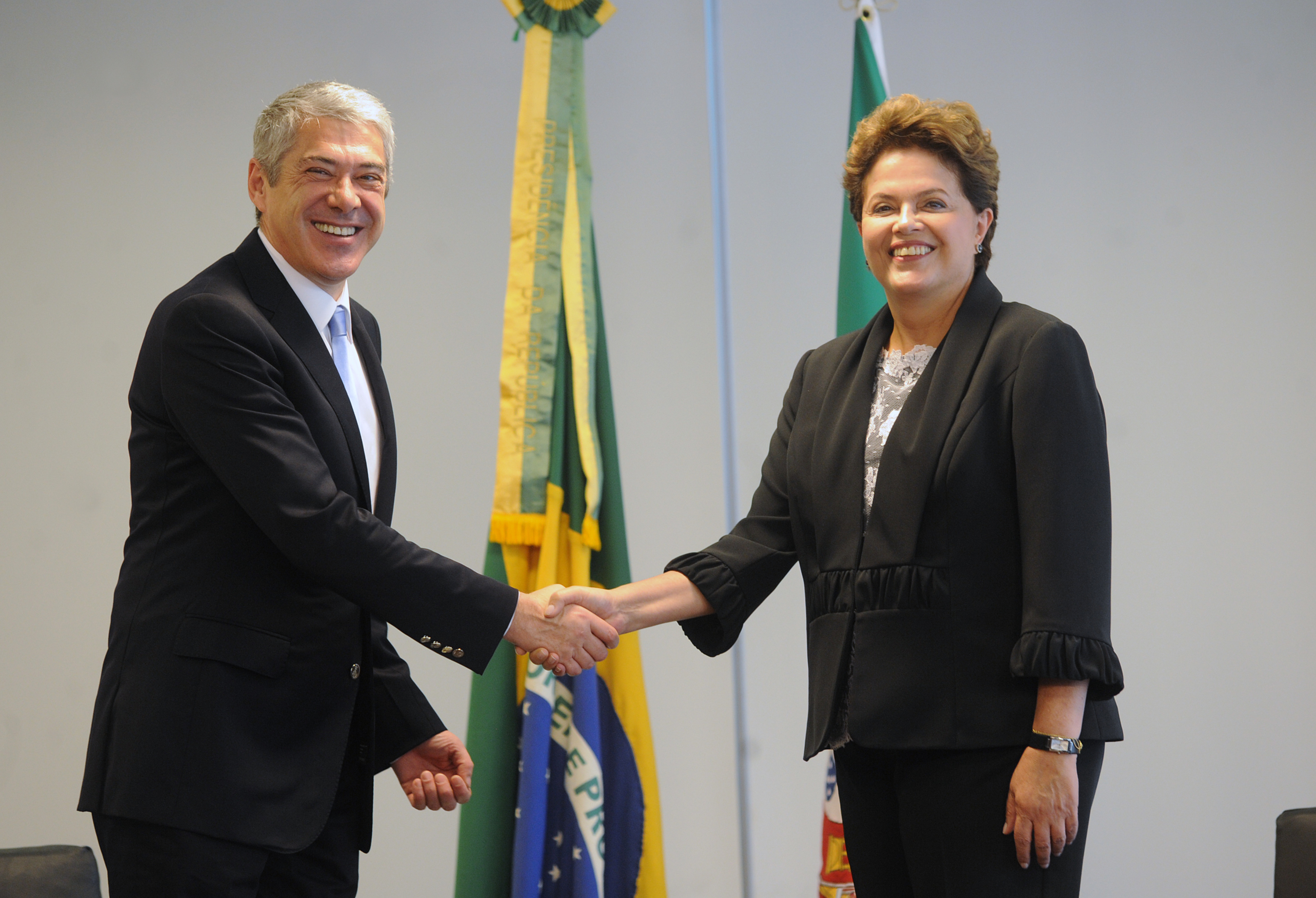
José Socrates, President of Portugal and Dilma Rousseff, President of Brazil
Knowing how to greet people in another language could mean the difference between making friends and remaining just another tourist: being informal can be offensive and too formal off-putting.
Brazilians obey a level of formality in greeting and addressing others that is not as rigid as the French, but not also not as informal as Americans.
Let’s look at some examples of formal and informal greetings.
Informal and used among family and friends:
Oi / Hi
Oi! Você chegou agora?
Hi! Did you just arrive?
Olá / Hello
Olá! Vocês estão bem?
Hello! How’s it going?
Tchau / Bye
Tchau, ligo para você depois.
Bye, I’ll call you later.
Até mais / See you
Vou para escola, estou atrasada. Até mais.
I’m going to school, I’m late. See you later.
Formal, used with older people, business associates of higher level and people you don’t know.
Bom dia / good morning, boa tarde / good afternoon, boa noite/ good evening or good night
Bom dia, posso ajuda-lo?
Good morning, can I help you?
Como vai? Or Como está? How are you?
Como vai? Vamos começar a reunião?
How are you? Shall we start the meeting?
Até logo / Good bye
Espero encontrá-la novamente, até logo.
I’m looking forward to seeing you again, good bye.
When addressing people, Brazilians use expressions of formality such as, o senhor (you, formal masculine) and a senhora (you formal feminine), usually followed by the person’s first name, rarely by the last name, and the verb agrees with the third person singular.
Bom dia, o senhor poderia esperar um instante?
Good morning, could you wait a little.
From the translation it doesn’t seem so formal, but compare it with the informal treatment:
Oi, você pode esperar um pouco?
Hi, can you wait a bit?
Sr. Paulo, o senhor gostaria de mais alguma coisa?
Mr. Paulo, would you like anything else?
Notice how the title Sr. is followed by the first name, and then instead of using você, the speaker continues to use o senhor.
Look at another example using the feminine.
Senhora diretora, a senhora poderia marcar uma reunião para amanhã?
Ms. Director, could you schedule a meeting for tomorrow?
It’s also important to note that in spoken Brazilian Portuguese, people will often substitute senhor for seu and senhora for dona.
Dona Sandra, que prazer revê-la!
Ms. Sandra, it’s a pleasure to see you again!
Seu Alexandre, gostaria de apresentá-lo ao Seu Alberto.
Mr. Alexandre, I’d like to introduce you to Mr. Alberto.
A rule of thumb is that you use você for anybody who’s younger or your peer in a company and o senhor /a senhora for those who are older or hierarchically higher.
And finally, Doutor or Dr. is not only reserved for doctors or lawyers, but also functions as an honorific title.
O Dr. Artur é o president da nossa empresa.
Dr. Artur is the president of our company
You can consult your Essential Brazilian Portuguese lesson 1, or Intermediate lesson 4 for more information. If you don’t yet have our Portuguese course, you can listen to a conversation between people meeting in an office setting on our Language Lab or if you are just starting to learn Portuguese, practice basic greetings in this set of flashcards on our Language Lag.
