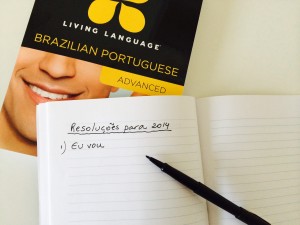
Eu vou estudar mais português.
With 2014 right around the corner, many people have already started elaborating that which deems us eternal optimists—our list of resolutions for the New Year.
Some people will limit their list to a number of promises they believe they are likely to keep, others will add to it their dreams, hopes and expectations, making it challenging to accomplish, but poetic and inspiring nonetheless.
However you compose your list, one thing is certain, you will write it using verbs in some form of future tense, for example: I’m going to study more Portuguese in 2014, or I will learn more verbs in 2014.
Like Americans, Brazilians will also write their New Year’s resolutions and try very hard, at least during the first few weeks of the incoming year, to remember and follow it. Similarly, they will also use some form of future tense to create it.
Let’s review the different ways of expressing the future in Portuguese and then, to practice, you can write your New Year’s resolutions in Portuguese while also being able to check the I will study more Portuguese column!
Using the Future in Portuguese
1. Futuro próximo, immediate future, is used to express an action in the near future. It’s formed with ir, to go, and followed by the main verb in the infinitive. You can use this to talk about plans, decisions and expectations. It’s therefore very useful for composing your list.
Example: Eu vou comer menos bolos, doces e chocolates. I’m going to eat less sweets, candies and chocolate.
Eu vou ajudar mais pessoas no ano que vem. I’m going to help more people next year.
2. Futuro do indicativo corresponds to the English future using will. It is formed by adding the endings -ei, -á, -emos, -ão, to the infinitive of the verb.
Example: Nós venderemos mais mercadorias no próximo ano. We will sell more merchandise next year.
Vocês terão mais oportunidades no futuro. You will have more opportunities in the future.
3. You can also talk about the future using the present tense, although this is more common for schedules and timetables;
Example: O avião parte às nove da noite. The plane leaves at 9 in the evening.
As aulas começam às oito e terminam ao meio dia. The lessons start at 8:00am and end at 12:00pm.
For your list in Portuguese, start with ten verbs typically used for New Year’s resolutions. Here are some examples:
parar, to stop - Eu vou parar de assistir televisão todas as noites e ler mais livros. I’m going to stop watching TV every evening and read more books.
ajudar, to help – Eu vou ajudar mais os meus pais em casa. I’m going to help my parents more around the house.
estudar, to study – Eu vou estudar mais verbos e expressōes idiomáticas em português. I’m going to study more verbs and idiomatic expressions in Portuguese.
trabalhar, to work – Eu vou trabalhar menos durante os fins de semanas e passar mais tempo com a minha família. I’m going to work less on the weekends and spend more time with my family.
comer, to eat – Eu vou comer mais coisas saudáveis. I’m going to eat healthier things.
Now you try using these verbs: chegar, to arrive / beber, to drink / economizar, to save / começar, to start / fazer ginástica, to workout.
Feliz Ano Novo com paz, amor e prosperidade! Happy New Year with peace, love and prosperity!