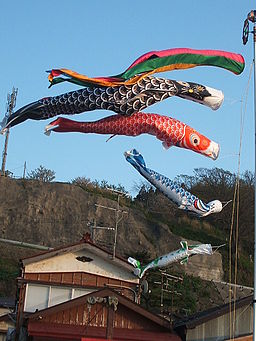
こどもの日 Kodomo no hi Children’s Day is celebrated in Japan on May 5, and it’s a national holiday. It also happens to be part of ゴールデンウィーク gooruden wiiku Golden Week. This is a period of time in early May when we find four different national holidays close enough to have the whole week off from work. (Check out my post on Golden Week from last year!)
Back to Children’s Day; it is a day when families with small children wish health and happiness for them. Children’s Day was originally called 端午の節句 Tango no sekku. 端午 tango is a classical Japanese word that refers to the beginning of summer; 節句 sekku means season’s festival. The day was originally set aside to wish health and happiness of boys. (For girls, there is 雛祭り Hinamatsuri on March 3.) However in 1948, the government set this day to celebrate the happiness of all children as well as making it a national holiday.
Traditionally, families raise the carp-shaped flags called こいのぼり koinobori. The origin of carp flags is said to be the Chinese legend that a carp that swims upstream becomes a dragon. Thus, carp flags symbolize success in life.
Families with boys also place 兜 Kabuto, which replicates the traditional Japanese military helmet, in their living room.
The celebration also features some fun menu items: 柏餅 Kashiwamochi (mochi rice cakes wrapped in oak leaves) and ちまき Chimaki (which is extra sticky rice wrapped in a bamboo leaf) are usually served on Children’s Day.
