Every language has its complicated sentences specifically designed to create difficulties for the speaker in articulating each word properly. Often, these are in the form of a word game, or a song since similar sounds become motifs that rhyme well together. Even for native speakers, these can be a challenge (and sometimes a source of embarrassment!)
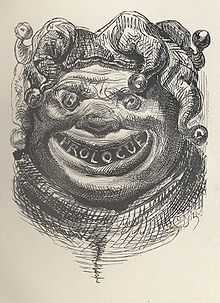
Pantagruel, by Gustave Doré
Contrepèterie (spoonerism) is a word play in which corresponding phonemes or syllabes in a phrase are switched to create a new one. Often, this new phrase presents a subversive and sometimes indecent meaning masked by the apparent innocence of the first phrase.
The author François Rabelais is often seen as one of the first to use spoonerism as a comic literary device. In his ‘Pantagruel’, we find many examples such as “il n’y avoit qu’une antistrophe entre femme folle à la messe, et femme molle, à la fesse.” Subsequent writers in literature also employ it with various effects: Victor Hugo: “J’ai fait le bossu cocu, j’ai fait le beau cul cossu.“; Robert Desnos: “un temple en stuc de pomme le pasteur distillait le suc des psaumes“; or “Aimable souvent est sable mouvant.“
Science professor Luc Etienne (also known as “régent d’Astropétique au Collège de Pataphysique“) became a specialist in the art of spoonerism, inventing the name contrepet (itself with a double meaning), and wrote the Art du contrepet, a work still in reference today: “Épuisée par une longue queue, la pauvre femme s’affale devant le bazar.”
Tongue Twisters In French, such phrases are called virelangues (or casse-langues or fourche-langues). French language has a profusion of such playful locutions or short stories:
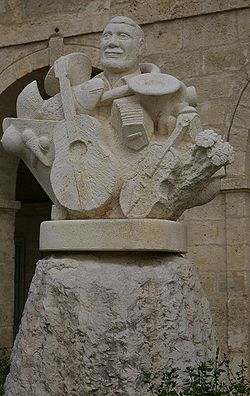
Monument in hommage of singer Boby Lapointe
“Chat vit rôt.
Rôt tenta chat.
Chat mit patte à rôt.
Rôt trop chaud !
Rôt brûla patte à chat.
Chat quitta rôt.”
Boby Lapointe is a French singer who became famous for his masterful but charming combinations of puns, spoonerisms and other rapid tongue twisters. Like Luc Etienne, Boby Lapointe was fond of mathematics and developed elaborated codes for pronunciation. Here is an excerpt of ‘Mon père et ses verres’:
“Mon père est marinier
Dans cette péniche
Ma mère dit la paix niche
Dans ce mari niais
Ma mère est habile
Mais ma bile est amère”
“Ta Katie t’a quitté” remains one of Lapointe’s most beloved creations. Below is the song with the accompanying lyrics:
