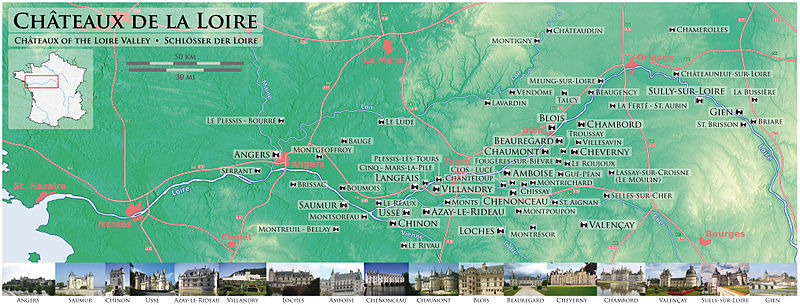
Châteaux de la Loire
Never fully tamed and used for navigation, the Loire river and its surrounding lands have remained predominantly rural. The rolling hills with occasional vineyards, the quiet villages strewn near the banks of a strong flowing river and a special, suffused light that seem to pervade the air all confer a peculiar charm to this part of France that has attracted the French aristocracy throughout history.
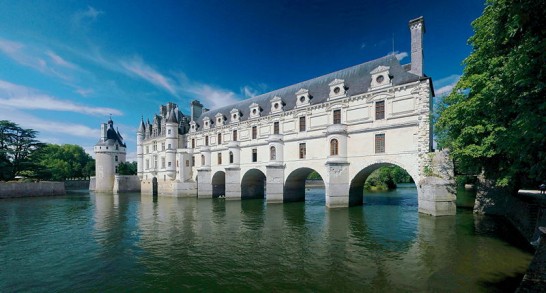
Château de Chenonceau
These kings, court favorites and other members of the nobility chose to erect second residences on a smaller scale than those found near the capital. Tuffeau (Tufa), a variety of limestone found near the river, was extensively used for the construction of the châteaux de la Loire (Loire castles). The white stone gives the edifices a stately yet airy, luminous, look.
Reminiscent of the royal splendor of the court, Chambord is the largest of the Loire castles, impressive in its blend of medieval forms and classical architecture of French Renaissance, and majestically circumscribed by the strong geometries of a vast expanse surrounded by woods, the Parc de Chambord. King Francis I supervised its construction in 1519, in a sophisticated style influenced by Leonardo da Vinci who was then the court architect.
With its blue slate roofs adorned with many spires, small turrets and towers, the château d’Ussé presents an eminently picturesque aspect, evoking a world of legends. Indeed, it is said to have inspired the fairytale Sleeping Beauty by Charles Perrault.
Somewhat an exception in the collection of Renaissance structures found in the Loire Valley, the Château d’Angers is a rare example of a well-preserved medieval fortress. Perched on the highest point of the town of Angers, it overlooks the Maine river. Its massive walls contain
the legendary Tenture de l’Apocalypse, a stupendous tapestry finished around 1382. Originally over 400 feet in length, it is composed of a series of tableaux illustrating the Apocalypse by Jean.
Despite its relative small size, Azay-le-Rideau is one of the most famous castles in the Loire Valley. A first castle was built in High Medieval Ages; the present architecture dates from early 16th century for the Treasurer-General of the Finances of King Francis I.
