-
Russian is the 8th most spoken language in the world by number of native speakers and the 5th by total number of speakers. The language is one of the six official languages of the United Nations.
In 2013, Russian ranked as the second-most used language on the Internet after English.
Please answer the following questions when you have time:- What interesting facts do you know about Russian?
- What other countries do you know besides Russia where Russian is also spoken?
- Name your favorite Russian authors.
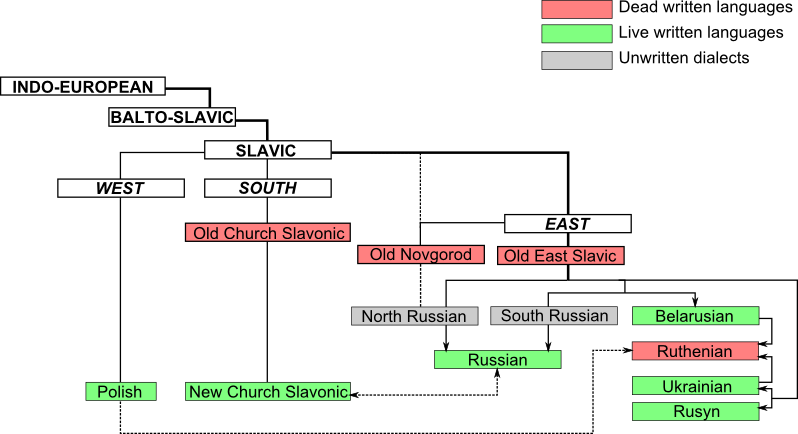
http://upload.wikimedia.org/wikipedia/commons/7/71/East_Slavic_Languages_Tree_en.png
We'd love to hear your thoughts and interesting answers! :-)
Также, пожалуйста, задавайте мне вопросы! Я всегда рада на них ответить.
Спасибо!
Пока,
Натaша -
Natasha, I did wonder if Lithuanian, Latvian and Estonian fall into the "West" branch of your chart above?
I have liked reading Dostoevsky and Pasternak, and have also read Tolstoy's Anna Karenina. I would love to know the Russian beginning of this book, or quoted in English "All happy families are alike, every unhappy family is unhappy in its own way."
I also enjoy playing and listening to Tchaikovsky and Rachmaninoff, though playing the latter requires big, strong hands I think.
-
Tim, thank you for the comment and your answers!As for the Lithuanian, Latvian and Estonian languages, they don't fall into the West branch of the chart even though they still belong to a bigger Indo-European language family, noting that Estonian (being close to Finish) completely differs from Lithuanian and Latvian. http://en.wikipedia.org/wiki/Baltic_statesGreat choices of the Russian authors!Have you read the poets, Сергей Есенин / Sergey Yesenin (http://en.wikipedia.org/wiki/Sergei_Yesenin) and Владимир Маяковский / Vladimir Mayakovsky (http://en.wikipedia.org/wiki/Vladimir_Mayakovsky)? They were prominent Soviet poets in the 1920-30s. Both had tragically ended their lives.Yesenin's poetry (in Russian/English): http://samlib.ru/w/wagapow_a/yesen.shtmlMayakovsky's poetry (in English): http://allpoetry.com/Vladimir-MayakovskyPlease let me know what poems you liked the most.Could you also post the links to your favorite compositions by Tchaikovsky and Rachmaninoff?This is one of my favorite by Tchaikovsky, Piano Concerto No. 1, Op. 23 (Pletnev - great Russian pianist):http://www.youtube.com/watch?v=0uoR76XEVPYHere is another favorite, Rachmaninoff's Piano Concerto No. 2:http://www.youtube.com/watch?v=pBx-tr1FDvYСпасибо!Наташа
-
Natasha Privyet!in answer to your questions, well let's see;1. interesting facts about (the) Russian (language?); for an anglophone it allows the experience of using the mouth in radically different ways. Several sounds are challenging to detect and to reproduce. Then there is the wonderful way of reading a word and hearing it spoken in a completely different way (I'm thinking of endings here in particular). Then there is that wonderful ability to place words in a sentence in (almost) any order and for it to still make sense(to a native speaker).2. the Russian diaspora is wide3. Hmm, favourite Russian authors; well we might have to consider sovyet authors as they then were; eg Bulgakov - Ukrainian by birth but lived and worked in Russia. So many others were also born from the diverse cultural groups living within the rodina but arguably were still Russian. Dostoyevsky of course for existentialist writings. Non Fiction / memoir 'writers' such as Zhukov and Chuikov from a historical perspective. Lukyanenko and Vasilyev for contemporary mass market SF. The problem of translation is irresolvable and thus I find that the english versions are shallow compared with texts I spoken about with native Russians. Poetry has again the problem of translation although lyrics by groups such as Piknik, Spleen and Maiden seem to have some clarity.4. music would be a whole different world from Termen (inventor of the theramin) to some of the folk music research conducted by Pyatnitsky in the early part of last century. Then there are the interesting contemporary groups following a European trend to combine traditional and 'rock' influenced sounds. Diverse isn't the word!:)5. re the linguistic chart above, I wonder what language group the Varangians belonged to? Also, what, if any, remnants of their language still exists in Russian today?Pakka, michael
-
Наташа
Thank you for the reply and links.
I have not have a chance to fully read (and digest)
either of the two poet’s works, but in general I liked some of the poems by Есенин such as Я обманывать себя не стану and
Не гляди на меня с упреком.
Regarding music, I took my daughter to see the Санкт-Петербургская aкадемическая
филармония perform
(когда они приехали в Анн Арбор
в феврале). Denis Kozhukhin played Tchaikovsky’s 1st
piano concerto that evening, though my daughter liked the encores with exaggerated
bass passages (she has started to play cello). Regarding Tchaikovsky and
Rachmaninoff, I very much enjoy Tchaikovsky’s Serenade for Strings in C and
Rachmaninoff’s Variations on a Theme by Paganini.
I play the piano, not well; strictly for my pleasure, torture
of the wife and kids. I like some of the smaller piano works. As I said in my previous
post, I cannot play well even the smaller Rachmaninoff works (impossibly long
stretches). Though everyone knows and loves the Opus 3 c# Prelude I like the
Opus 23 (10) Preludes more, especially #4 in D and #5 in g.
http://www.youtube.com/watch?v=ftxkamLqgzIhttp://www.youtube.com/watch?v=Y6JnK1dZITM
And I enjoy playing Tchaikovsky’s Времена года.
http://www.youtube.com/watch?v=wCvwSLv4aXw
There is also a very good performance on YouTube with
Pletnev playing these pieces. Also, coming up soon in Ann Arbor.https://www.facebook.com/events/1423628981187721/
Russian is the 8th most spoken language in the world. Find out more...