‘Le Corbeau et le Renard’, a fable from La Fontaine


Classics of French literature, the Fables de La Fontaine continue to work their magic on the imagination of both adults and children, for the power of their imagery, the relevance of their content, and the excellence of the language, which the French writer Flaubert himself admired.

The fable is a literary genre on the surface distinct from fairy tales. Both tell a story, but a fable is succinct, often in verse, and features natural or mythical creatures which are given human qualities, especially the ability to speak. The message and moral lesson they convey is generally immediately accessible. Thus, this format of storytelling proved very useful and effective in climates of repression when certain subjects might face censorship.

Here is one of the most famous fables of La Fontaine: ‘Le Corbeau et le Renard’:


Photo Credit: Wikimedia Commons

France’s ‘Comfort Foods’

If ‘comfort food’ means a dish associated with a sense of home or contentment, then it could be argued that most foods in France fit that label. Indeed, following the stereotype, French people regard food as altogether convivial, pleasurable and nourishing. In winter however, an emphasis is on warm, filling foods. Below are some classic examples (with links to recipes):

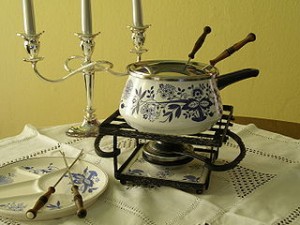
Fondue Bourquignonne

Fondue Bourquignonne: Swiss in origin, this dish involves a caquelon (name for the cooking vessel used for fondue) in which bite size pieces of beef (especially Charolaise, a breed of cattle from Burgundy) are plunged into hot oil by each guest. Once the meat is cooked, an assortment of sauces is used to accompany it, mainly mayonnaise, sauce béarnaise, and sauce tartare.

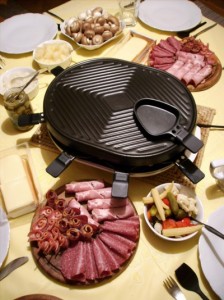
Raclette

Gratin Dauphinois: An oven-dish made with thinly sliced and layered potatoes and cream, with a thick browned crust of gruyère cheese. The Gratin Dauphinois is a speciality of the Dauphiné region.

Raclette: Like Fondue, people gather, this time around a four à raclette (little electric table-top grill) placed on the table. Each guest puts some semi-firm cow’s milk cheese (known as fromage à raclette) in small pans called coupelles inside the grill. Once melted, the cheese is poured over boiled potatoes, vegetables and charcuterie (deli meats).


Using Movies to Help Learn a New Language

You may not have seen Amour, but you probably know that it won the Oscar for Best Foreign Language Film. If you’re planning on watching it because it’s apparently a very good film, AND because you happen to be learning French, here is some advice that will help you enjoy the film and get a little French mileage out of it, too. Naturally this applies to any language you happen to be learning and any film in that language that you’d like to see!

First, watch the film. If you really want to use a film as a learning tool, it’s a very different experience from watching a film for pleasure. And it can suck all the pleasure out of the experience, especially for anyone who you might be watching the film with but who isn’t interesting in learning the language. So first, sit back and enjoy the film as a film.

Film’s over? Great, now you’re familiar with the plot, and you probably remember a scene or two that were short, manageable, and easy-ish for you to follow without the subtitles. Ideally you want something that’s only a few minutes long, because you’re going to be spending some time with it. Find one of those scenes, pause at the beginning, and go through it like this.

1. Keep the subtitles on and watch the scene once more. No doubt you’ve forgotten a few lines, so this is a chance to remind yourself of the details of what’s being said.

2. Jot down any new vocabulary that came up that you can isolate from comparing the audio to the subtitles. Use the pause button liberally to milk the scene for all of its new language content, and don’t worry if you can’t follow every single word or aren’t familiar with every single grammatical construction.

3. Repeat this once or twice if you need to, until you’re comfortable with the scene. You want it to be familiar enough that you’re picking up lots of vocabulary you already know, along with some new words that you’re just learning because of the subtitles.

4. Go through it one more time, this time with the subtitles off. See if there are any new words you can squeeze out if from the context.

Now that you’re really familiar with the scene, go back to beginning, keeping the subtitles off, and play through it sentence by sentence. Or phrase by phrase, since people don’t always speak in complete sentences. The goal is to listen carefully to each sentence, and see if you can:

5. Pick out the new and familiar vocabulary. It should be getting more and more familiar, and you’ll be surprised at how many new words you’re adding to your lexicon.

6. Look for examples of grammar that you know. Listen for verb forms, examples of adjective agreement, pronouns, etc. This will vary depending on your level, but it will always help build your listening comprehension and put the grammar that you’re learning in a course in a realistic, actual context. Learning to examine other speakers’ grammar will help your own.

It may seem a bit silly to spend so much time focusing on one short scene of a foreign language film. But this will help you do a few things. First, you’ll solidify the vocabulary and grammar that you already know by seeing examples of it. Second, you’ll learn some new vocabulary, and maybe even a new structure. Third, you’ll hone your listening comprehension skills by training your ear to pick out familiar words and constructions against the backdrop of natural speech. This is a vital skill! And finally, you’ll learn how to become an active listener in your new language. You’ve got to put forth more listening effort than in your native language, training yourself to focus carefully on known cues or context.

Les Misérables: Victor Hugo’s famous novel and this year’s Oscar Nominee

Victor Hugo


With the theater release of the quasi-operatic Les Misérables last Christmas, the classic story of redemption by VIctor Hugo receives yet another incarnation, this time based on the successful stage musical.

Jean Valjean during the crossing of Paris in the sewers

Les Misérables (The Wretched, The Miserable Ones) is a French historical, social and philosophical novel on an epic scale, filled with tragic characters such as the ex-convict Jean Valjean and his protégée, the lovely but victimized Cosette. Set in early 19th-century France, the story is painted against the background of important events like the Bataille de Waterloo and the Paris Uprising of 1832, an unsuccessful anti-monarchist insurrection.

Hugo, a member of the prestigious Académie française, was not only a prominent figure in the world of French arts and letters, but also increasingly involved in French politics. After publicly accusing Louis Napoleon (Napoleon III) for establishing an anti-parliamentary constitution, the writer was eventually forced into exile on the island of Guernsey. There, he would live from 1855 until 1870, composing some of his best work, including Les Misérables.

Cosette

For the author, the novel embodied the ideals of romanticism and his views on human nature. At its publication in 1862, Victor Hugo wrote to his editor: « Ma conviction est que ce livre sera un des principaux sommets, sinon le principal, de mon œuvre.” (“My conviction is that this book will become one of the main summits, if not the main summit of my body of work.”)

Despite critical reviews, the novel quickly became an international commercial success, and one of the most popular of French literature. Today, it retains its captivating power, with its universal themes of social justice, romantic and familial love.


Random Acts of Kindness

Did you know February 17th is Random Acts of Kindness Day? Make someone smile by using some of these phrases in the language you’re learning.

SPANISH

  • ¡Que pase un buen día! Have a nice day!
  • ¡Cuídese! Take care!
  • ¡Qué lo pase bien! Have a good one!
  • ¡Buen viaje! Safe travels!
  • ¡Recupérese pronto! Get well soon!
  • ¿Puedo ayudarle? Can I help you?
  • ¡Me alegro de verte! Nice to see you!

Italian

  • Per favore / Per piacere (please)
  • Grazie (thanks)
  • Prego (you are welcome)
  • Che gentile! (how kind of you!)
  • Ben educato (well mannered - note that educato is a false friend, education is istruzione)


CHINESE

  • 你好 nǐ hǎo (Hello)
  • 最近好吗? zuì jìn hǎo mā? (How have you been?)
  • 很高兴见到你 hěn gāo xìng jiàn dào nǐ (So nice to see you)
  • 好久不见 hǎo jiǔ bú jiàn (It has been a long time)
  • 请 qǐng (Please)
  • 谢 谢 xiè xiè (Thank you)
  • 对不起 duì bù qǐ (I’m sorry/Excuse me)


French

  • Je suis désolé. (I am sorry)
  • Vous permettez ? (May I/do you mind?)
  • Après vous ! (After you!)
  • Merci de votre aide. (Thank you for your help.)
  • Vous êtes très gentil/aimable. (You are very nice/kind.)


Below are some words and phrases related to gestes de gentillesse (acts of kindness):


  • Être gentil avec quelqu’un (to be nice with someone)
  • Envoyer une carte de voeux (to send a greeting/wishing card)
  • Faire un calin à quelqu’un (give somebody a cuddle)
  • Souhaiter bonne chance à quelqu’un (to wish someone good luck)
  • Aider une personne âgée à traverser la rue (to help a senior citizen cross the street)
  • Donner/tendre la main à quelqu’un (to hold out one’s hand to somebody)
  • Offrir des fleurs à quelqu’un (to offer flowers to somebody)


Arabic

Courtesy is important no matter what country or culture you’re in. The Middle East is no exception when it comes to certain phrases that have become vital for everyday conversation.
Some courtesy phrases which are vital for your conversation in Arabic are:


  • من فضلك، لو سمحت (min faDlik, law samaHt): please, would you please
  • شُكراً (shukran): thank you
  • عفواً (xafwan): you’re welcome
  • آسِف (‘aasif): sorry
  • نَعَم (naxam): yes
  • لا (laa): No


Japanese


  • ありがとうございます。Arigatoo gozaimasu. “Thank you.”
  • ありがとうございました。Arigatoo gozaimashita. “Thank you.”


This phrase has the past tense ending. Use it when you want to thank for some favor that has been done to you. For example, you can say it to your teacher at the end of your Japanese class; to your host when you leave a house party.

  • ごめんなさい。Gomennasai. “I’m sorry.”
  • すみません。Sumimasen. “Excuse me”, “I’m sorry”, “Thank you.”


This phrase is very versatile! Say it quickly and lightly and it will mean, “Excuse me”. Say it slowly and sincerely and it will mean, “I’m sorry”. Say it with a big smile and it will mean, “Thank you”; how is it different from ありがとうございます Arigatoo gozaimasu? すみません sumimasen is used when the speaker especially appreciates the sacrifice and efforts made for him/her.


  • どうぞ Doozo. “Please.”


Use this expression when you offer something to somebody.


  • お願いします。Onegaishimasu. “Please.”


Use this expression when you accept a favor from somebody, such as “Would you like some coffee?”. You can also use this when you ask somebody a favor.


  • 大丈夫です。Daijoobu desu. “I’m okay.”


You can use this when somebody asks you, 大丈夫ですか Daijoobu desu ka (“Are you okay?”). But you can also say it when you mean, “No, thank you.”


  • 失礼します。Shitsureeshimasu. Literal translation: “I’m being rude.”


Don’t worry too much about what it literally means. Native speakers don’t really think about it either! What is important is to know “when” to use. Use it when you enter somebody’s room or residence. Also use it before you hang up a phone. It is a very polite expression and you’ll give a very good impression if you use it!


Contributors: Anna, Max, Khung, Sev, Hkebbe, Sakura
Photo Credit: Thinkstock

‘L’Amour, toujours’ - Valentine’s Day in France

Quel est ton Valentin/Valentine ? Who is your Valentine? (m/f.)

Fêter la saint Valentin (to celebrate St Valentine’s Day) often means offering des petits cadeaux (small gifts) in the form of flowers, a romantic diner, wine and chocolates. France has some of the most famous chocolatiers (chocolate makers) in the world. Here is a comprehensive French website on the subject.

Despite distant pagan origins and its assimilation by the Roman Catholic church with the saint patron (patron saint), le jour de la Saint Valentin or simply, la Saint Valentin is more associated with the mutual exchange of billets doux (love letters).

Here are some French words and phrases related to Valentine’s Day if you’re planning on writing love letters yourself:

  • échanger des mots tendres, des mots d’amour (to share sweet words, love words)
  • lui faire une déclararation d’amour (to declare one’s love to him/her)


Here are some famous quotes from French literature and arts:

Jamais il ne se passe une heure sans penser à toi ; je t’aime.” (lit. There is never an hour that passes without thinking of you ; I love you.) - Napoleon Bonaparte love letter to Joséphine in 1796)

Mon cœur ne bat que pour toi.(My heart beats only for you.) - J.M. Guyon

T’as de beaux yeux tu sais.” (You’ve got beautiful eyes you know) - from the 1938 movie Quai des Brumes (Port of Shadows, lit. Pier of Mists).


Listen to this song by Georges Brassens, Les amoureux des bancs publics (Lovers of public benches). Note the use of se bécoter (to kiss each other), a somewhat old-fashioned verb for lovers. (lyrics and translation here)

Send a Card to a Friend!

Contributors: Max, Sakura, Sev, Khung, Anna

Get out your stationary-today is Send a Card to A Friend Day! Why not write your card in the language your learning? Our etutors have gathered some common words and phrases that are perfect for greeting cards. Check them out here!

Photo Credit: Thinkstock

Italian

If you are sending a card to a friend, the language is informal. However if you are writing something more official, the language becomes very formal and with multiple variations according to the status, age, etc of the recipient.

  • Caro/a/i/e (Dear …)
  • Un caro saluto (A dear greeting)
  • Saluti (Greetings)
  • Baci (kisses) or Un abbraccio (a hug)


Japanese

To write a greeting card in Japanese, start with “To [addressee]“. This can be done by writing the hiragana character (pronounced “e”) following the addressee’s name. There’s no particular fixed phrases for signing off a casual letter, but here are a couple of suggestions:

また会えるのを乐しみにしています。
Mata aeruno o tanoshimi ni shiteimasu.

(I’m looking forward to seeing you again.)

素敌な一年になりますように。
Suteki na ichinen ni narimasuyou ni.

(Wishing you a wonderful year.)
(A nice closing if you’re sending a birthday card or a New Year’s card.)


French

Sending une carte (a card) or une carte virtuelle or e-carte (e-card) to a friend can make such a special impression when you want to mark an event or send your wishes. What if you were to write one in French, even just for the fun of it?

French people usually start with:

Cher (Dear) [friend's name] (or simply his/her name)

Depending on the occasion, there are possible variations:

Aujourd’hui je pense bien à toi car c’est ta fête ! (Today I think a lot about you because it’s your name day!)

Je te souhaite de passer de belles vacances (I wish you wonderful holidays; lit. I wish you to spend beautiful holidays)

Bravo pour ton diplôme ! (Congratulations for your diploma!)

Je t’envoie cette petite carte pour te féliciter de ce magnifique succès. (I send you this little card to congratulate you for this magnificent success.)

Je te souhaite un joyeux/merveilleux anniversaire. (I wish you a wonderful/happy birthday.)

You can end with:

A très bientôt (See you soon)

(Gros) bisous or (Grosses) bises (big hugs; lit. big/fat kisses)

[Your name]

Note: In France, une bise or un bisou are kisses which are not romantic. They are used between friends or family, regardless of the gender. If it’s between a mother, and aunt and kids, you could also use Je t’embrasse (bien)(fort). (lit. I hug/kiss you quite/much strongly.)


Chinese

For Chinese people, when we send a card to a friend, we will write “Dear _______ (亲爱的 qīn ài de _______ ”, or “Hi _______ ( hài, _______ )” at the beginning. At the end of the card, we usually sign off the letter with “Sincerely yours (诚挚问候 chéng zhì wèn hòu )“ or “Hope you are well祝 好 zhù hǎo )”


Spanish

Dear friend, Querido amigo,

I hope that everything is good for you and your family. Espero que todo esté bien para ti y para tu familia.

I miss you and I hope we can see each other very soon. Te echo de menos y espero que podamos vernos muy pronto.

Warm regards from your friend, Un afectuoso saludo de tu amigo,


Using Japanese in Real Life

Living Language Note: Over the next few months, our new friend Eric will be learning Japanese and sharing his journey on the blog! When he’s not studying with Living Language Platinum Japanese, Eric is an English instructor at Temple University’s Tokyo campus and at Kikokushijo Academy. Make sure to leave a comment & say hello in the language you’re learning.

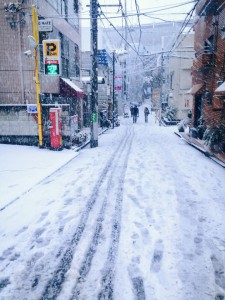
Yoyogi Uehara in the snow

It’s a new year, and I’ve moved to a new apaato (apartment) in a beautiful neighborhood of Tokyo called Yoyogi Uehara. I’m loving the new setting—young, vibrant, and best of all, social! That being said, I’ve really got to step up my game in learning Japanese.

I had a moment recently where I realized that I know more Japanese than I thought! I was talking to a friend about where I’m from, where I live now, and where I plan on going in Japan, and some tricky Japanese verbs came into play: ikimasu (to go), kimasu (to come), and kaerimasu (to go back home or to your home country). It’s a bit difficult for native English speakers to get the hang of this at first, but with practice, it will come to you. For example:

I told my friend that I was going to Kyoto, using ikimasu: Watashi wa Kyoto e ikimasu. (I’m going to Kyoto).

Then I said I was going home to Yoyogi Uehara, using kaerimasu: Watashi wa Yoyogi Uehara e kaerimasu. (I’m going home to Yoyogi Uehara).

And then I mentioned that a friend is coming to see me in Yoyogi Uehara, using kimasu: Tomodachi wa Yoyogi Uehara e kimasu. (A friend is coming to Yoyogi Uehara).

Of course, the best way to get the hang of any language is to use it! Having studied to become a language teacher myself, I try to make sure that I apply whatever I’ve learned in my Japanese lessons to real-life situations. The more you can personalize the language point, the easier it will be to use it. So, my tip for all you other language learners out there is to try to find a way to connect what you’re learning to your personal experiences, interests, and surroundings. A good place to start is via eTutoring or by talking with someone you know in the target language (for example, a friend or a language partner).

Gambatte (good luck) to all you other language learners out there, and keep up the good work!

Work Culture Abroad

Have you ever wondered what it’s like to work abroad? Our etutors weigh in on work culture in different countries.

Japan

By Sakura

Japanese work hours and work ethics are very similar to American ones, but perhaps the most unique cultural component of work life in Japan involves the use of honorific language. This formal style is required when speaking to both superiors and customers or clients. There is an honorific form, when the subject of a sentence is a superior, and a humble form, when the subject is yourself. Let’s take the verb 行きます ikimasu, which represents the regular form of “to go”. If you want to say that a superior is going, you use the honorific form いらっしゃいます irasshaimasu. Conversely, if you want to tell your superior that you are going somewhere, you use the humble form 参ります mairimasu. The formal style can be quite tricky. For young people, just starting out in their professional careers, using the honorific form can be a humbling experience replete with embarrassing moments, making errors. Yes, even native speakers sometimes have to struggle with the Japanese language!

Italy

By Max

Work (lavoro) is difficult to generalize: work is seen with either a positive or negative connotation according to areas and cultures. Some people find hard work (lavoro duro) something to avoid as it decreases quality of life. Some others find quite the opposite. The word for office employee in Italian is impiegato. Piegare means to bend over, hence the impiegato bends his/her back over to work. This should give you an idea.

Overall, in Italy, the work environment is way more laid back than in the USA. Also, Italians tend - and like - to underplay and make fun of work, even when they have exceptional achievements: as a Christopher Walken’s T-shit once said “Dance and shut up” — i.e. just do things, do not talk about them. We do not brag about, for instance, ”pulling an all-nighter” because 1) it simply implies you did not do your job properly before, hence you have to work during the night 2) we are aware that brain needs rest and there is something called a learning curve.

Spain

By Anna

In Spain, work hours are often ruled by the meals. For Spaniards, meal breaks are very important, especially lunch, which it is taken sometime between 1pm and 3pm. Spaniards like to take their time eating, and we spread our meals out during the day. That also means that we adapt our commercial hours and office hours to our eating habits.

The midday meal, la comida as it is called in Spain, is the largest meal of the day. Usually we take a break between 1 and 2 hours to eat la comida and un cortado (expresso coffe with a bit of milk). This means going back to work after lunch and instead of finishing at 5pm we finish at 7pm or later. These work hours are very common in towns and neighborhoods with many local businesses. When I was a kid my brother used to pick me up from school at 1pm, we arrived home after a 10 minute walk and we enjoyed a long meal with our parents, who also had a two hour break from work. Schools started again at 3pm and my mother opened the doors of her own local store at 4:30pm.

In my home town near Barcelona all stores are closed between 1:30pm and 4:30pm and rush hour is 6pm. This is changing as more and more big companies open their doors without a midday break. Of course big chains, malls and large stores do not close their doors at lunch time! Work hours are changing slowly, especially in the downtown areas of big cities like Barcelona and Madrid. The standard office hours are 9 to 6 with a one hour break to eat. However it is not a big deal if you need 15 more minutes to digest la comida.

Lunch is always a time to sit down, eat, and hang out with colleagues. You will rarely see office workers having sandwiches on-the-go, or grabbing a small thing to eat for lunch at the corner store. It is also common in business to stop meetings to take lunch with a long sobremesa (hang out time at the table after the meal is over).

It’s Thesaurus Day!

Contributors: Hkebbe, Ginger, Sev, Max, Sakura, Anna

Today we celebrate the birthday of Peter Mark Roget, born January 18, 1779. His Thesaurus of English Words and Phrases was published in 1852. Roget’s Thesaurus is still used today.

We’ve asked our etutors to give us some synonyms for common words you might already know. Take a look!

Arabic

English word translation synonyms
big كبير ”kabiir” ضخم “Dhakhm” (huge)
beautiful جميل ” jamiil فاتن “faatin” (pretty)
happy سعيد ”saxiid” فرحان “farhaan” (glad)
friend صديق ”Sadiiq” خليل “khaliil” (close friend)
delicious لذيذ is “ladhiidh” شهي “shahiy” (tasty)

Chinese

beautiful 漂亮 piào liàng měi
happy kuài 开心 kāi xīn; 愉快 kuài; 欢喜 huān xǐ; 愉悦 yuè; 喜悦 xǐ yuè
friend 朋友 péng yǒu 友人 yǒu rén
delicious 美味 měi wèi 好吃 hǎo chī 可口 kě kǒu
angry 生气 shēng 愤怒 fèn nù ;气 qì fèn

French

big grand/ grande (m./f.) large (wide)
beautiful beau / belle (m./f.) mignon/ mignonne (m./f.) (cute)
friend ami / amie (m./f.) copain/ copine (m./f.) (friend, informal); petit ami/ petite amie (m./f.) (boyfriend/ girlfriend)
delicious délicieux /délicieuse (m./f.) savoureux /savoureuse (m./f.) (tasty)

Italian

big grosso/a/i/e grande/i Example: “sei un grande (you are a cool guy)
beautiful bello/a/i/e Example: Sei bello come il sole. You are beautiful. (lit. You are as beautiful as the sun) attraente/i
happy felice/I Example: E’ felice come una Pasqua. He/she is very happ.y (lit. He is as happy as Easter.) contento/a/i/e
friend amico/a/amici/amiche compagno/a/i/e
delicious delizioso/a/i/e buono/a/i/e

Japanese

big 大きい ookii 大きな ookina can also mean big. The only thing to keep in mind is that 大きな ookina has to be followed by a noun. For example, you can say 大きな木 ookina ki big tree, but if you want to say the tree is big, then you must use the adjective 大きい ookii instead.
beautiful 美しい utsukushii きれい kiree (The adjective 美しい utsukushii is not used very casually in Japanese. Instead, きれい kiree, which means pretty is used often. So whenever you want to say, It’s beautiful!, say, きれい Kiree!
happy 幸せ shiawase 嬉しい ureshii means pleased, but it is used in many contexts where English speakers would say happy. For example, if you want to say, I’m happy to see you in Japanese, it will be お会いできて嬉しいです Oaidekite ureshii desu.
friend 友達 tomodachi 親友 shin-yuu means close friend or best friend. For example, ジョンは私の親友です Jon wa watashi no shin-yuu desu means John is my close/best friend.

Spanish

big grande (sing.) / grandes (pl.) gran, enorme (very big)
beautiful bonito (sing. masc.) / bonita (sing. fem.) / bonitos (pl. masc.) / bonitas (pl. fem.) guapo/guapa (related to people meaning handsome/pretty)
happy feliz (sing.) / felices (pl.) contento/contenta (glad)
delicious delicioso (sing. masc.) / deliciosa (sing. fem.) / deliciosos (pl. masc.) / deliciosas (pl. fem.) rico/rica (delicious)
friend amigo (sing. masc.) / amiga (sing. fem.) / amigos (pl. masc.) / amigas (pl. fem) colega (does not mean colleague- false cognate)